
Before You Buy: Our Family’s Questions That Changed Everything
My little family story of how and why we shifted from mindless consumerism to a more sustainable and thougthfoul consumption and the embracing of the “make do” philosophy. And why and how you can too, at your own peace.
For my husband and I the birth of our first child changed, well … everything in our life! And soon after, the outside world literally went upside down overnight due to the Pandemic. These major shifts have had a huge impact on our perspectives and our behaviours as a family, as citizens, as consumers.
When we were “child free” our life was workaholic and punctuated with endless convenience purchases, from take out to useless clothing (that fifth pair of high heels shoes was superbe, but I barely worn them twice), to continous grocery shopping (often ending in the bin because the food got spoiled)… everything was as fast as it could be.
And when our lovely “burden of joy” arrived, things did not go better. I was buying and buying stuff for him, out of the fear that he could lack something: would he have enough diapers? Enough clothes? Tons of different lotions for a little eczema (that disappeared spontaneusly once he dropped the pacifier…) … we buy -often what we do not really need- for many different reasons: fear, social pressure, to entertain ourselves, to feel accepted… the list goes on.
This lifestyle starts very soon in our existences.
We are literally “bombarded” since the moment we are born wih a constant message: “BUY NOW”… and you will feel better, “BUY NOW”…and you will be accepted by your peers, “BUY NOW”…and… YOU WILL BE HAPPY. This is an enourmous lie.
Yes, there is that instant gratification, that spike of dopamine when you swipe your credit cart in the shop and go out proudly showing your shopper to the world. But that feeling will not last long and soon after your will be -most of the time- be left will a sense of dullness, as if that purchase does not mean anything. On the contrary, that purchase will be there to encomber your closet, to remember your that you unwittingly spent your money and that it has costed precious resources to be produced.
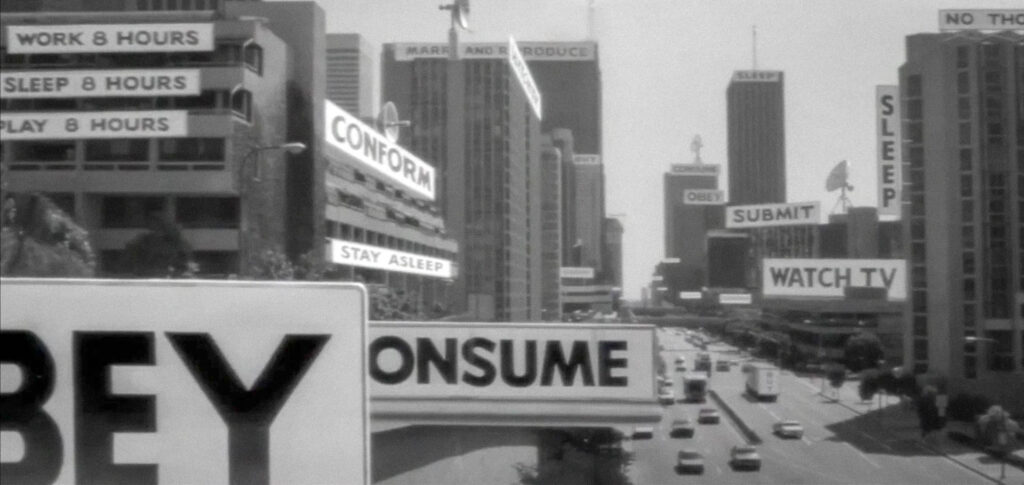
I cannot help to think about the cult sci-fi b-movie “They live” by John Carpenter, where the main characther, Nada, discovers that the world’s ruling class are actually aliens who induce humanity to consume and to conform to the existing social order through subliminal messages hidden in mass media. For a deeper insight on the movie, you can go trought Wikipedia
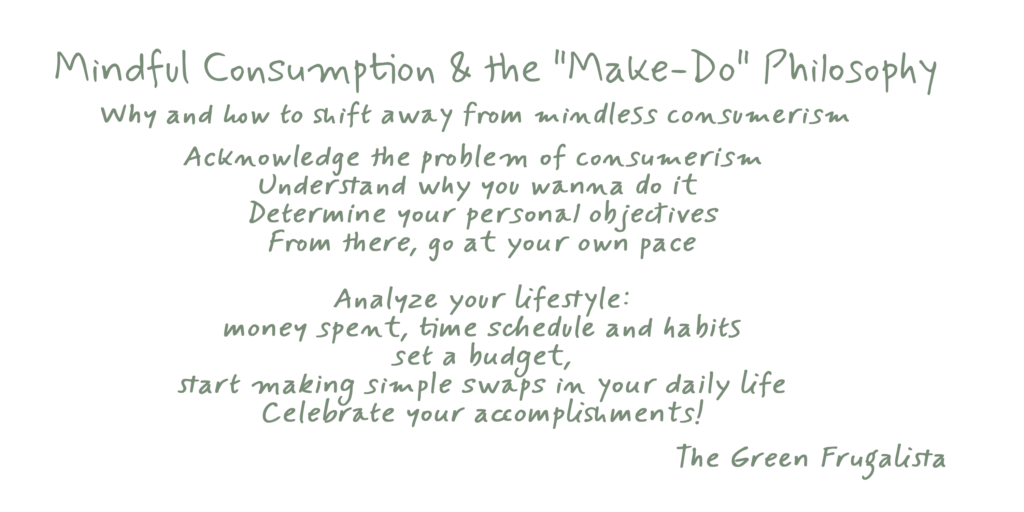
The question is, “what can you do about it?” One important step is to acknowledge that there is a problem. Then, some analytical and objective approach to your lifestyle will make you understand how your spend your time and your money. It is a kind of puzzle, you deconstruct, analyze, adjust and reconstructe, ONE LITTLE PIECE AT A TIME.
I think it is primordial to understant that this is a process and it will take time.
You have to ask yourself why you wanna do it,
what would be your objectives
and from there go at your own pace.
I am wary of people that tell you that things like zero waste are simple, that everyone can do it, because that is not the case; it is not simple at all. On the contrary, there are questions that are extremely complexe and need time, understandig and effort. It is important to do it little by little to avoid discouragement and to quit the process. As we say in italian: “Nessuno nasce imparato!” (No one is born knowing everything)
Start with simple swaps; for example, no more bottled water or, if you feel like, sew your own cotton make-up pads and stop buying the disposable ones. And, most of all celebrate that attainment! This kind of actions give you an incredible and lasting sense of accompliment and you feel more in control of your life.
The shift from automatic purchasing to thoughtful consumption
Going back to our family story, when we were forced to slow down, I had the chance to reflect and I realized how much of the things we owned were simply unecessary. I started looking in our bank account statement, diving in the evergrowing pile of little sales tickets lying in my vide-poches and looking to online purchases to understand how so much of our money was spent. The findings were sometimes even shocking! At the time I had not a fixed budget for our everyday life. I did not think we were living large but finding out how much I spent only for groceries made me understand I had to do something about it.
I decided where I wanted to head: cut the bills, limit food waste and -paradoxically- eat better.
All of this process took time and some effort but today I can proudly say that I have a budget I very rarely depass (that can happen too!), we eat lots of in season fruits and veggies and our food waste is at a bare minimum.
My family’s framework for deciding what truly deserves space in one’s home
As of today, whenever we would like to buy something beyond of groceries and regular utilities, we ask ourselves a few questions:
Do we already possess something that could be a substitution?
If that’s not the case, do we absolutely need that object in our home?
In case we need it punctually, is there any mean to borrow/rent it?
As long as we finally decide to do the purchase, especially if it is an expensive one, we wait at least 24 hours. NO rush, you always deserve a time to let your decision mature.
The aim is to buy something that will be around as long as possible, that is repairable, whose spare parts are somewhat available (and here I must thank my geek husband for owning an awesome 3D printer that saves us a lot of stuff in the house! But this is a story for another post!) and that has been produced in the best possible ethical conditions with circularity in mind. Think for example natural fibres that naturally decompose against artificial ones that spread microplastics during all -their very long!- lifecycle.
You might be thinking: “Hey, all of this sounds nice, but also demanding!” Yeah, but if you rarely do that, because you do not go shopping every other day for anything that crosses your mind, it is well worth to put some effort and time to make an informed decision.
Creative make-do solutions I discovered along the way
Then, whenever you decide that you will not buy that object, there are other options too. Creativity here is essential, and trust me, you will notice you will start develop original solutions if you get used to think this way.
For example, the fabrics you can retrieve from beyond repair clothes can still give value before being tossed. Without spending an euro you can for example make “zokins” -the japanese name for rug, -I love how the japanese can permeate anything ordinary with a flair of poetry!-; produce bags for grocery shopping; make-up pads; oven mittens; some other new clothes, and the list goes on… suggestions are very welcome!
The “Make-Do” Philosophy
While learning several different DIYs along the way, such as mending or yogurt making to lowering food waste, I discovered what “make-do” is. At the beginning I thought it was a grammar mistake…either your make, either you do … so sorry, my english did not get there!!! Then, I finally opened a dictionary an discovered the actual meaning:
Cambridge Dictionary – Make do
“To manage to live without things that you would like to have or with things of a worse quality than you would like: We didn’t have cupboards so we made do with boxes.”
In italian, I would translate that with: “L’arte di arrangiarsi” and I found this concept absolutely fascinating.
I discovered some booklets (to know more about this topic, please refer to my post: www.tgf.com) that were published in the US and in the UK during the WW times. These are little gems full of practical tips for women in order to contribute to the war effort by making the best possible use of -the then restrained- resources they had. From mending, to cultivating a small vegetable garden in their backyards, all this absolutely sounds like being frugal, and most of all being proud of that frugality vis à vis of the society. This paradigm has been inverted since that time.
Saying “not right now” has paradoxically made my family feel more abundant.
I do not feel deprieved at all. On the contrary, I think I’ve gained so much from this mental shift, as I feel much more in control and resilient in my life. I do not crave some other “new and shiny things”, I am actually content and satisfied with what I own… I know I sound like a buddhist, but that’s exactly how it feels!
I hope this little writing of mine can make you consider to become more aware of your choices, because, as trivial as it may sound to say it, everyone deserve it.
Let me know what you think and if you are willing to start such a journey. If you are already there, please, feel free to share your observations and findings!
— The Green Frugalista